Precision Timing and Quantum Metrology involves basic and applied research on the positioning, navigation, timing, and frequency aspects. Innumerable applications of this science and technology are a silent infrastructure that is the backbone of modern-day living – GPS/GNSS, telecommunication synchronization, power grid synchronization, precise navigation, definition & maintenance of the Universal Coordinated Time (UTC), and various strategic applications – only to name a few. Our work covers the basic research on spectroscopy of atomic and optical clocks and their applications – ranging from timescales, time- and frequency- synchronization techniques, to precision quantum sensors (atomic clocks and magnetometers) and basic metrological studies. Inception of the group at the University of Alabama occurred in January 2022.
Dr. Thejesh Bandi is leading our Precision Timing and Quantum Metrology research along with Dr. Adam Hauser and Dr. Patrick LeClair. The group has various collaborations within UA: with faculty in the department of Engineering (UA), department of mathematics, and the UA Transportation Institute. We have an Educational Partnership Agreement (EPA) with the United States Naval Observatory (USNO). A recent funding from NSF-NRT under the ACCEPT (Alabama Collaborative for Contemporary Education in Precision Timing) program – where graduate level students are being trained in Precision Timing related research and leadership skills – has boosted our activities further.

Faculty Research and Interests
Current Faculty
Dr. Thejesh Bandi is an associate professor and NIST associate at the Time and Frequency Division. He is the Principal Investigator of the Precision Timing, Navigation and Quantum Metrology research Lab and the technical director of the ACCEPT program. His research interests span from basic atomic and ion spectroscopy to its novel implementation methods with the atomic and optical space clocks; metrological studies; time scales and synchronization schemes; and Artificial Intelligence (AI) novel methods for time and frequency metrology and to build safe methods of using Global Navigation Satellite System (GNSS) including the novel methods for alternate PNT. Dr. Bandi is also active in training the next-generation skilled manpower for the sustenance and growth of the PNT field. Dr. Bandi has built a first of its kind course in Precision Timing and Quantum Metrology to enable researchers in STEM fields for gaining the required knowledge towards a career in Precision Timing industry, academia, and the Government metrology and timing labs.
Dr. Adam Hauser is an associate professor and the Executive Director of the ACCEPT program. Dr. Hauser has been instrumental in driving the Precision Time and Frequency basic infrastructure at the University of Alabama since 2019, including the efforts of the EPA with USNO. He has gathered elite board members to the ACCEPT program from various institutions, industries, and Government organizations around the United States. A platform well set for the students towards exciting placements in Precision Timing and Frequency. His research interests in Precision Timing are time and frequency synchronization.
Dr. Patrick LeClair is the professor and department chair actively involved with the Precision Timing research and training activities. The lab spaces and infrastructure for the Precision Timing research, including the setting up of the thermally isolated rooms for the inhouse timescale has been his contributions. Dr. LeClair has built an ultra-low-phase-noise measurement setup which can characterize the low-noise oscillators and atomic clocks. He is a Co-PI in the ACCEPT program for training the graduate level students for the Precision Timing industry. His research interests in Precision Timing are noise characterization methods for the oscillators and clocks, including the electronics for synchronization and data acquisition methods.
Dr. Sergei Gleyzer is an associate professor and an active collaborator. With his extensive expertise in Machine Learning and Artificial Intelligence, Dr. Gleyzer has been involved with the application of ML/AI algorithms for research in Precision Timing and Quantum Technology. He is a Co-PI in the ACCEPT program. His research interests are to apply machine learning and artificial intelligence methods in Precision Timing and Quantum Technologies.
Equipment
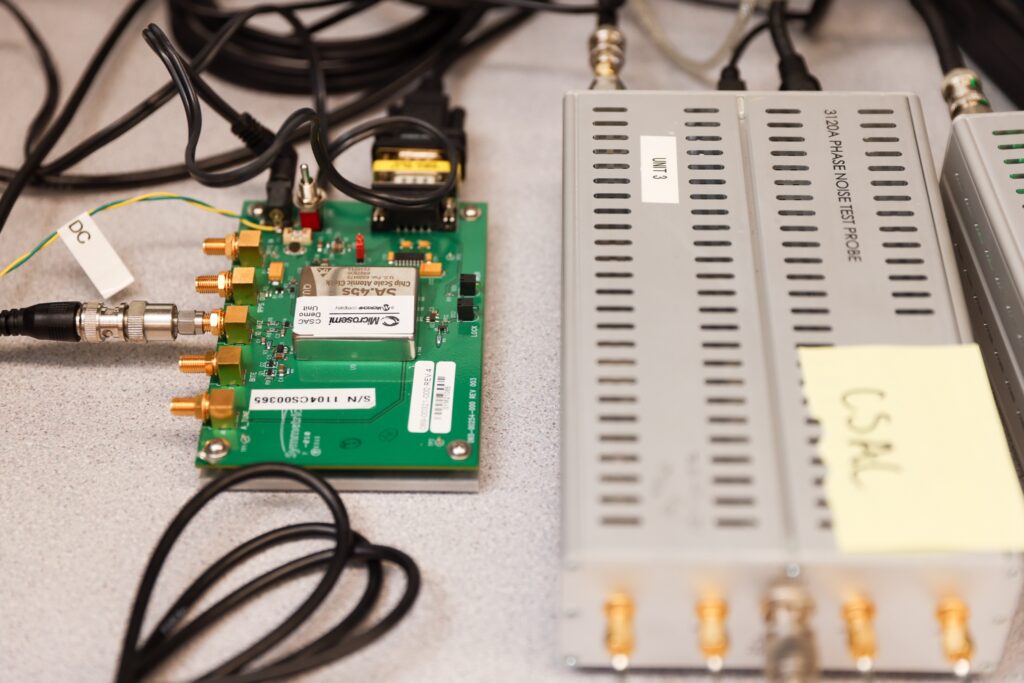
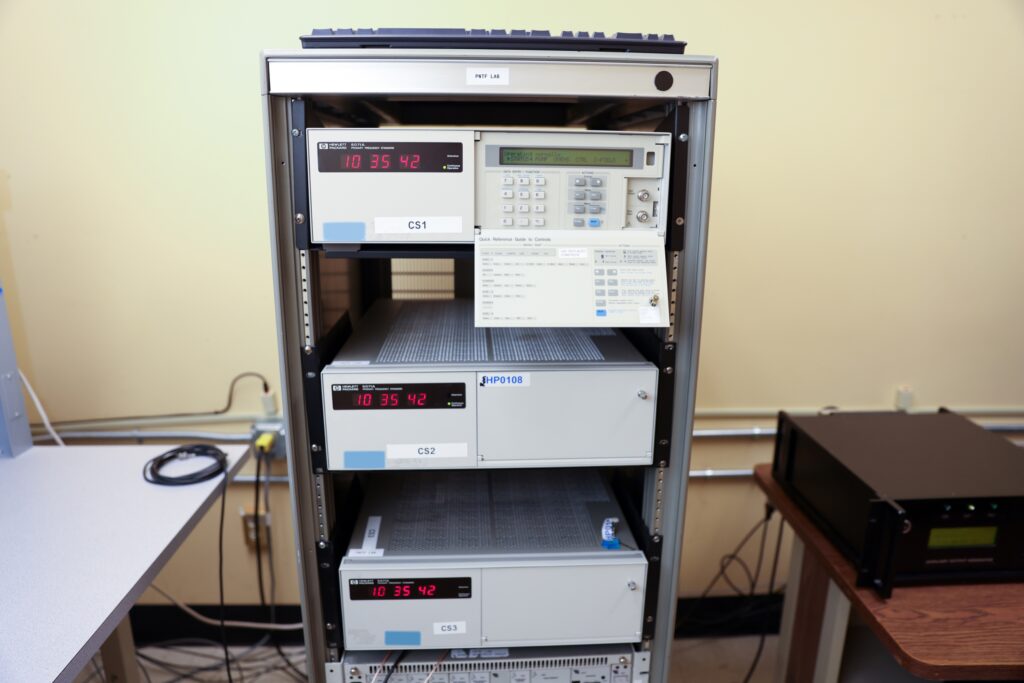
The Precision Timing and Quantum Metrology labs consist of Cesium and Hydrogen MASER atomic clocks, miniature and chip-scale atomic clocks, timescale apparatus, GNSS antennas and receivers, phase noise measurement systems, time synchronization equipment, lasers, microwave & optical cavities, and optical components.